Digital Notice Board for HR: Why Paper Notices No Longer Reach Your People

The notice board by the canteen door has been the backbone of workplace communication for decades. It is also where good announcements go to be ignored. A digital notice board keeps what worked — a shared place everyone passes every day — and fixes what did not.
The problem with the paper notice board
Most HR teams know the pattern. A circular is printed, pinned, and within a week it is covered by the next one. Holiday lists stay up long after the holiday. The fire-drill notice sits under a canteen menu. Nobody can say whether the night shift at the second plant ever saw the new leave policy, because nobody can say who read anything.
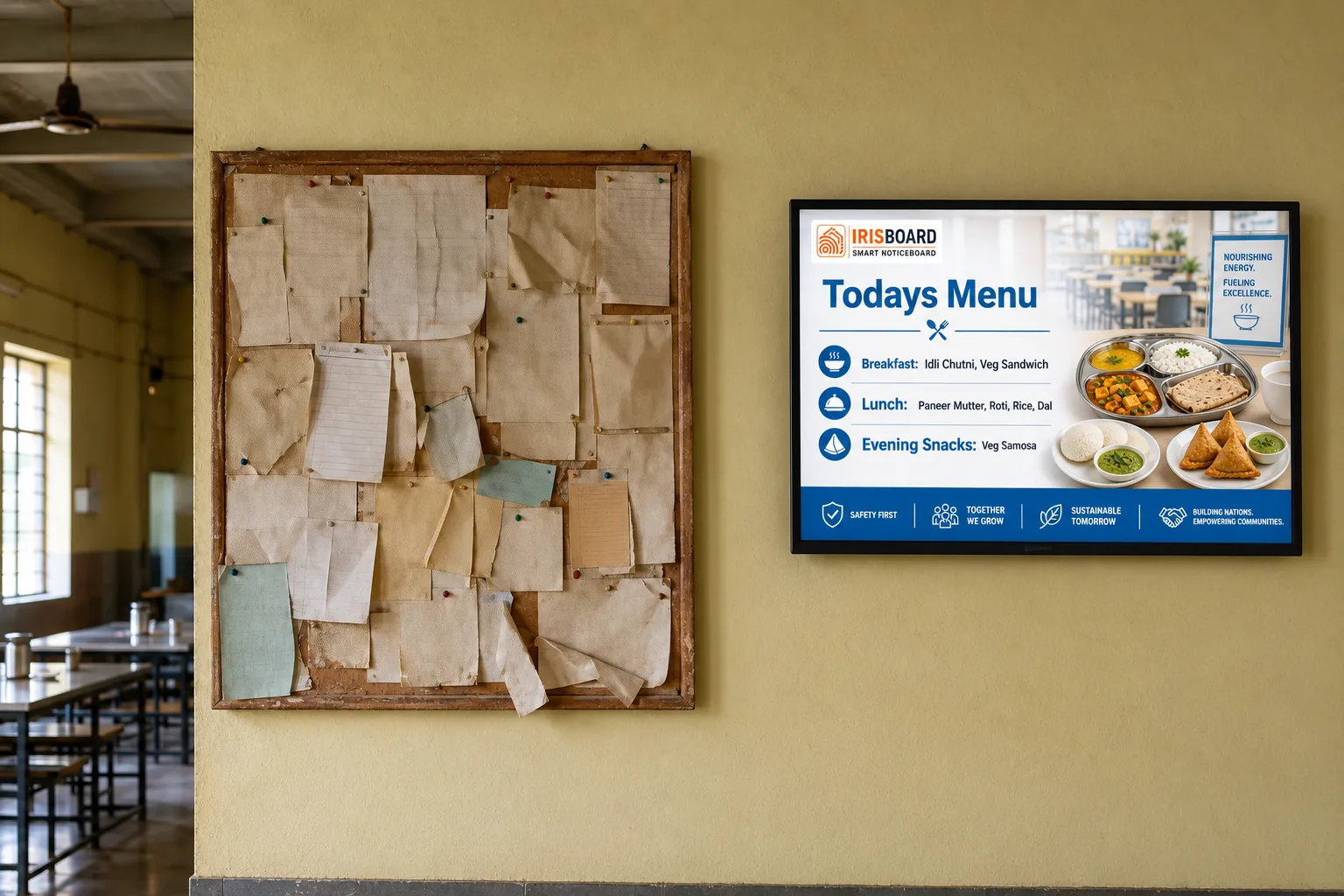
Email and chat groups solve part of this for people at desks. They do little for the employees who make up most of the workforce in manufacturing, logistics, retail and hospitals — people who do not sit in front of a screen all day, may not have a work email address, and should not be reading WhatsApp on a production line.
For those employees the wall is still the channel. The question is whether it is a wall that works.
What a digital notice board actually is
A digital notice board is a screen — usually an ordinary TV — in a place people already pass: the entrance, the canteen, the time office, the shop floor. Instead of paper, it plays notices that HR publishes from a web console. Change a notice once and every screen that carries it updates. Schedule it to start on Monday and it appears on Monday. Set it to end on Friday and it is gone on Friday, without anyone walking round with a staple remover.
It is sometimes called digital signage for HR or an employee communication display. The difference from generic advertising signage is who it serves: it is built for internal announcements, approvals and multiple sites, not for selling products to passers-by.
Five things that change when the board goes digital
1. Notices arrive on time, everywhere at once
One publish reaches every screen at every location you choose — head office, the plant two states away, the warehouse. There is no courier of printouts and no lag between the site that got the email first and the site that got it last.
2. Old notices disappear by themselves
Every notice has a start and an end date. The board shows what is current and nothing else, so the one notice that matters is not buried under six that expired.
3. Urgent messages take priority
A plant shutdown, a weather warning or an evacuation instruction cannot wait for the next rotation. A flash notice takes over the selected screens immediately and the normal programme resumes by itself afterwards.
4. The right message reaches the right site
A shift change in Pune has nothing to do with the office in Mumbai. With screens grouped by site, each location sees what applies to it, while company-wide announcements still go everywhere.
5. You can see what is on every wall
From one console, HR can check what each screen is playing, whether it is online, and what was published, by whom and when. That record matters the day someone asks whether a policy change was communicated.
"But who is going to design all these notices?"
This is the question that stalls most digital-signage projects. A screen that shows the same three slides for a year is no better than paper. The work is not the hardware — it is producing a steady stream of clear, good-looking notices without a design team.
Modern HR noticeboards address this with AI. In IRISBOARD, for example, an HR executive types a short brief — a title and a few details — and the notice is written and the poster designed automatically, in the company's brand colours and tone. It can be reviewed, adjusted or regenerated before anything is published, and a library of ready-made content covers the recurring topics such as safety, wellness and festivals.
Language matters on the shop floor. A notice in the language people actually read is a notice people actually read. Look for a system that can produce notices in the regional languages of your workforce — Hindi, Marathi, Tamil, Telugu, Gujarati, Bengali or Kannada — rather than only English.
Do you need new hardware?
Usually not. Most workplaces already have TVs in canteens and reception areas. A digital notice board can run on an existing Android TV or an inexpensive Android TV stick plugged into any screen, and newer systems also run straight in a smart-TV web browser. What matters is that the screen keeps playing when the internet drops — a board that goes blank every time the Wi-Fi hiccups loses trust quickly. IRISBOARD screens keep playing what they have already downloaded and catch up when the connection returns.
Governance: who is allowed to publish?
A screen in a public area is a company voice. Before rolling out, decide:
- Who creates notices at each site — typically a site HR or admin login.
- Who approves them — so nothing reaches a wall without a second pair of eyes.
- Which screens each person can publish to — a site login should reach its own site's screens, not the whole company's.
A good HR noticeboard enforces these rules in the software rather than relying on everyone remembering them.
How to roll it out in four steps
- Start with high-traffic spots. Canteen, main entrance and time office at one or two sites. Prove it there before going everywhere.
- Seed it with a month of content. Holidays, safety reminders, a policy refresher and a few recognition posts, scheduled in advance, so the screens are never empty.
- Set the approval rules before you hand out logins.
- Retire the paper board once the screen is trusted — keeping both splits attention and brings the old problems back.
The short version
A digital notice board is not a gadget; it is the paper board doing its job properly. Notices arrive on time at every site, expire when they should, reach people in their own language, and leave a record. For HR teams responsible for employees who are not at a desk, it is the most direct channel there is.