How to Run a Safety Week: A Five-Day Plan with Ready-to-Use Notices

A safety week usually fails quietly. The posters go up on Monday, a speech is made on Tuesday, and by Thursday the plant is back to normal and nobody could say what the week was for. The ones that work have a plan: one theme a day, one action a day, and a visible thank-you at the end.
This is a five-day plan for a plant, warehouse or site, with the notice wording for each day. It assumes screens at the gate, the canteen and the shop floor, but every step works on paper too; screens simply take the repeating out of it.
Before the week: four things to settle
- Pick the dates. Many plants hold theirs around National Safety Day on 4 March, which falls in the National Safety Week of 4 to 10 March. Others choose a quieter week so production is not squeezed. Either is fine; just fix it early.
- Name one owner per day. Not a committee. One person is responsible for the theme, the notice and the activity.
- Decide what you will count. Hazards reported, hazards closed, drill time, attendance at the briefings. Without a number the week cannot be compared with the next one.
- Schedule the notices ahead. Write all five in the week before and set each to start and stop on its own day, so nobody is typing on a Monday morning.
The five days
Day 1: Wear it right
Open with something everyone can do immediately. Check helmets, gloves, safety shoes and eye protection at the gate, and let people fix a strap or swap a worn pair on the spot. The notice is short: the theme, and where the check is happening.
Day 2: Stop and look
Ask every person to walk their own line or area and report one hazard they can see: a loose cable, a blocked exit, a spill that keeps coming back. People notice what the supervisor has stopped seeing. Put a QR code on the notice that opens a one-line report form, so a phone is all it takes.
Day 3: Drill day
Run the evacuation drill and time it. This is the one day a flash screen earns its keep: it takes over every selected screen at once at the moment of the drill and hands back to the normal rotation afterwards. Remind people of their assembly point in the notice the day before, so the drill tests the plan rather than the surprise.
Day 4: Fix it
Close the hazards reported on Day 2, and say so. This is the day the week earns trust: people who raised something see it dealt with, and the next report comes more easily. Show the count: hazards raised, hazards closed.
Day 5: Thank you
Recognise the people who made it work: the best hazard catch, the cleanest line, the shift with the fastest drill. Announce the time and place on the screens in the morning and give the recognition in person. A certificate from a plant manager is remembered longer than a message.
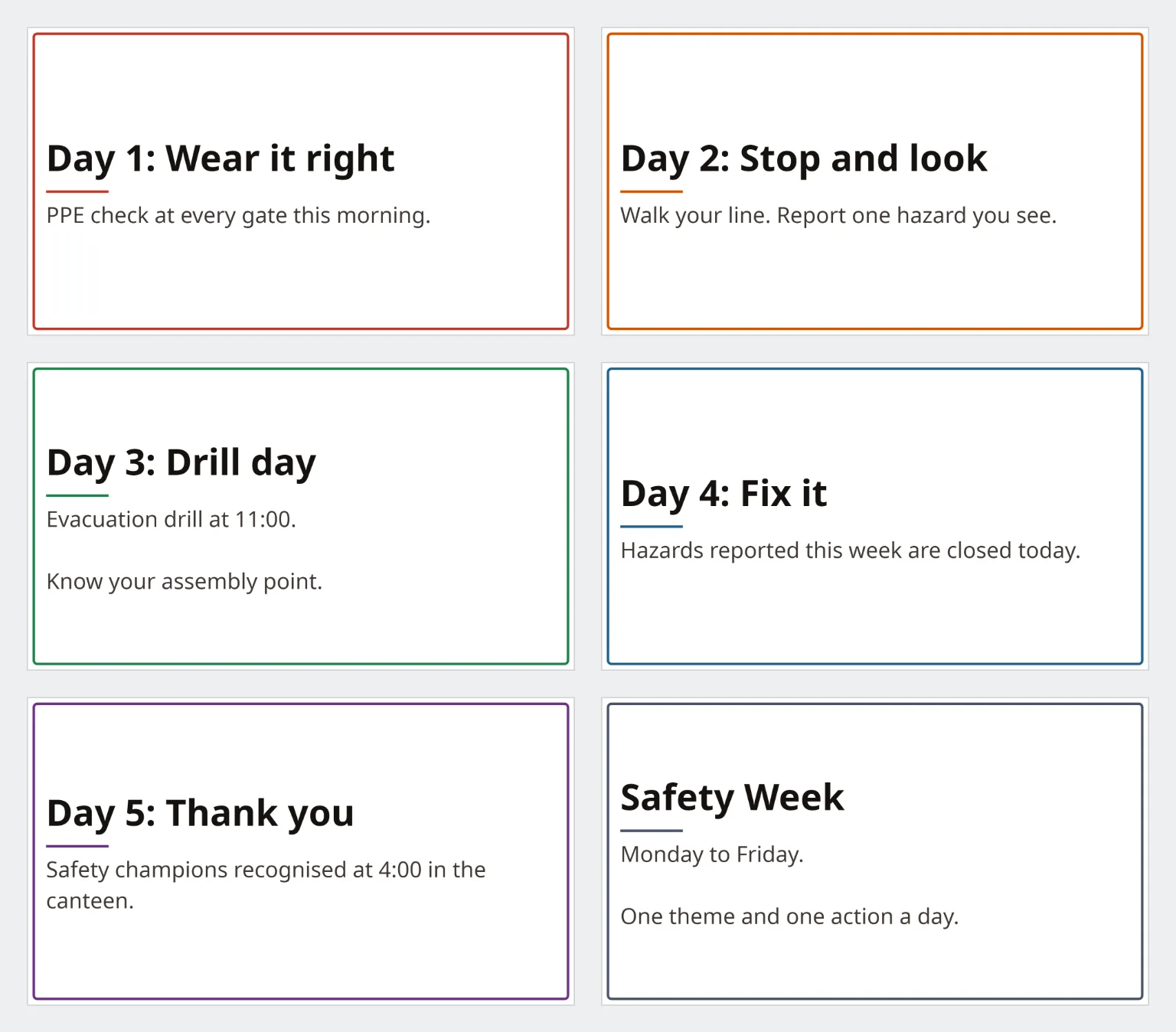
Making the week visible without adding work
- One message per screen. A headline readable from the back of the room, and a line or two underneath. A wall of text is read by nobody.
- Their language. Safety messages are the last place to rely on English alone. Publish the same notice in the language each shift reads; see which language a workplace notice should be in.
- Different screens, different jobs. The gate carries the reminder, the canteen carries the thank-you, the shop floor carries the hazard of the day.
- Keep your own wording. For safety instructions, the words matter. IRISBOARD can set your title, details and picture exactly as you wrote them, with no rewriting, which is what you want when the text has been approved by the safety officer.
Schedule the five notices together in one sitting. The week then runs on its own and the safety team spends it on the floor, not at a keyboard.
After the week: keep what worked
Write down the numbers on the Monday after: hazards reported and closed, drill time, turnout. Pick the one thing people mentioned most and make it permanent: a monthly hazard walk, a weekly toolbox talk, a standing "hazard closed" message. A week fades; a habit lasts.
That weekly habit is the subject of 12 toolbox talk topics that work on a screen, and the wider case for reaching people who are not at a desk is in how to reach frontline employees.